
Description is easy. Identification is hard.
A pressed coin is a copper or silver oval stamped with a design unique to the place that made it. Two coins from the same park can share almost everything: same metal, same oval shape, same brand logo at the top. They may differ only in a single character, a costume detail, or a tiny “3 of 7” in the bottom margin.
A general AI assistant will happily describe a photo: “a Lilo & Stitch penny with the two characters embracing.” That reads as smart, but it has not told you it is catalog number RES0177 rather than the four other Lilo & Stitch coins in the same set. Description is open-ended and forgiving. Identification against a fixed catalog is a precise, closed-set decision where “basically right” is wrong.
How the scanner works under the hood
There are two stages, and either can fail. First, a vision model reads the photo into structured fields: the legible text, the characters and what they are doing, the denomination, any series markings. Second, that description is scored against every coin in the catalog to find the best match.
The first stage is lossy by design. It turns a rich image into a handful of words, and the second stage can only work with those words. If the model writes “a Disney coin,” nothing downstream can recover which Disney coin. Most weak results trace back to this handoff. Here is what that looks like on real coins.
A misread that shares no letters
This Yak & Yeti restaurant logo is written in stylized, Tibetan-style script. The model reliably reads it as “Lake & Busch,” and sometimes splits it into broken fragments like “OAK” and “LETI.” Those readings share zero words with “Yak & Yeti,” so a purely generic matcher has nothing to connect them, and it often guesses a non-Disney park on top of that. Recovering it takes knowing that this specific misread maps to this specific coin.

The number in the margin
This Lilo & Stitch coin belongs to a seven-piece set and carries a small “5 of 7” near the rim. The other six coins can be visually identical in everything the model tends to notice. The only reliable difference is that series number. If the photo is sharp enough to read it, the right coin wins cleanly. If patina or a short roll hides it, the scanner is choosing between near-twins with no signal to separate them.

When the text is the whole coin
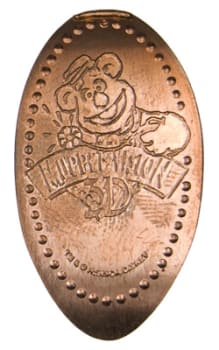
This well-patinated MuppetVision 3D penny shows a character above a banner reading “MUPPETVISION 3D.” When the banner reads, identification is easy and confident, because that text is unique. Darken the coin until the banner is illegible and the model returns “a Muppet character,” which competes with every other Muppet coin from the same park. The same coin swings from a confident match to a shrug based on whether four faint words survived the camera.
The coin with no text at all
Here is a textless penny: Roger Rabbit driving Benny the Cab, the cartoon taxi with headlight eyes and a grille for a mouth. There is nothing to read. Identification rests on the model naming the character as Roger Rabbit, not just “a rabbit,” and recognizing the vehicle. Give it a vague read like “a cartoon animal in a car” and it cannot tell Roger’s cab from a Mickey-in-a-car coin.

What it takes to do this well
Reliable identification needs domain knowledge, not just intelligence. A collector knows “Lake & Busch” means Yak & Yeti and recognizes Benny the Cab on sight. Our scanner keeps that knowledge in a clean, declarative registry that a generic matching engine consults, so teaching it a new coin means adding one entry, not rewriting the engine. Every example above is pinned by an automated test built from a real coin.
Two things matter as much as the matching. Photo quality is upstream of everything, so a lot of accuracy work is really camera work: focusing and sizing the image so faint text like “5 of 7” actually reads. And when scores legitimately cluster low, as they do for worn or textless coins, a clear leader over the runner-up is still surfaced rather than buried. The long-term answer for the hardest cases is visual similarity, comparing your photo directly against catalog images, which never needs the words at all.
Frequently asked questions
- Can AI identify a pressed penny from a photo?
- Often, yes. The scanner reads the coin into a structured description and matches it against the catalog. It works best when the design and any text are legible. Worn, textless, or heavily patinated coins are harder and may return a best guess rather than a confident match.
- Why does a coin scanner sometimes return the wrong coin?
- Usually because the photo did not give the model enough to go on. Stylized text gets misread, faint series numbers get missed, and textless coins depend entirely on naming the character correctly. A sharper, flatter, well-lit photo fixes most misses.
- How do I get the best scan results?
- Fill the frame with the coin on a plain background, avoid glare by tilting the coin or moving your light, and make sure any text or series number is in focus. Good lighting on a worn coin matters more than anything else.
- Does it work on worn or patinated coins?
- It can, but it is harder. When age hides the distinguishing text, the scanner may only narrow it to a family of similar coins. Confirming the design against the catalog match is the reliable final step.
Related guides
More reference material lives on presscoins.com , catalog background, news, and longtime collector guides.